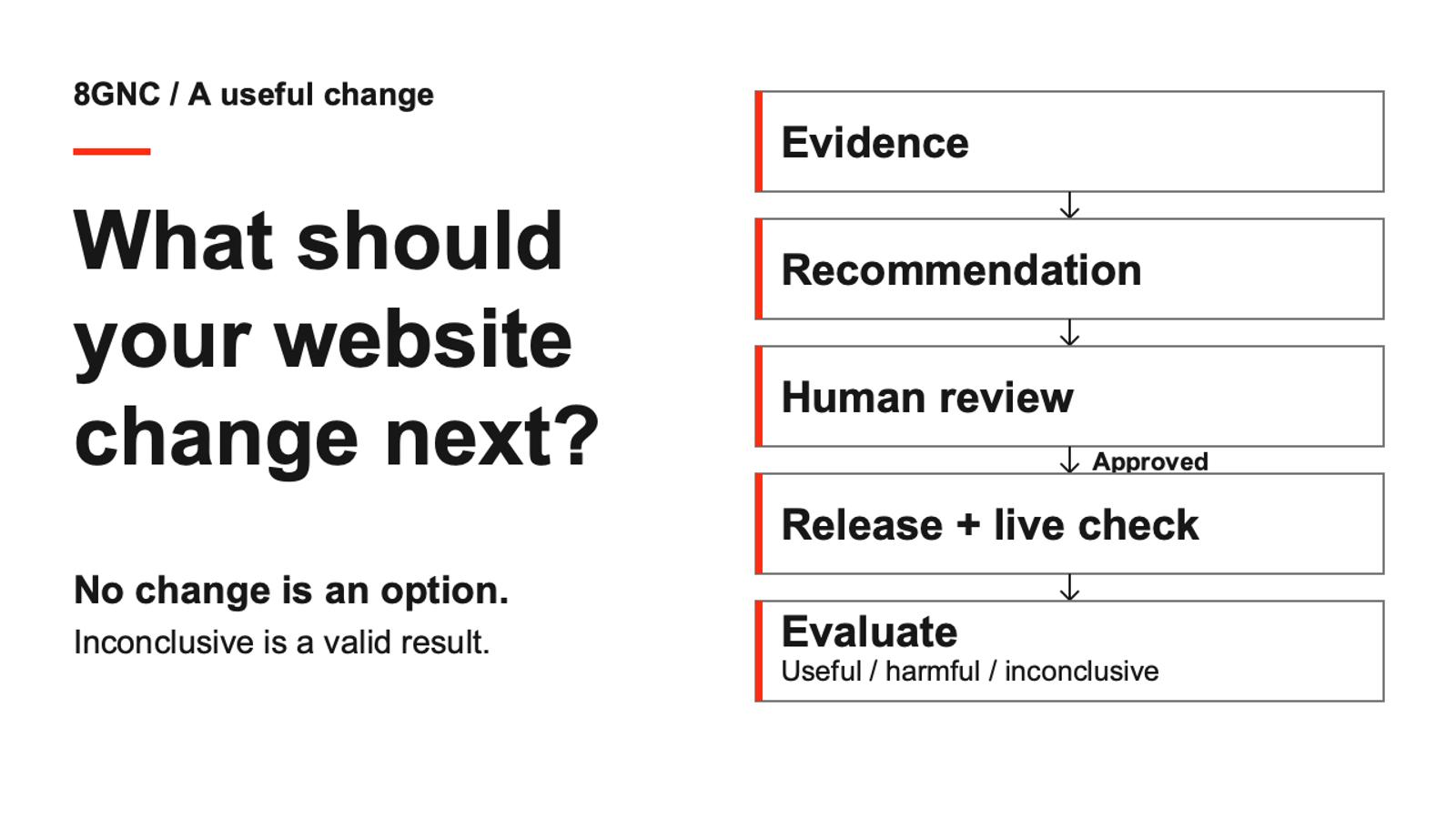
What should your website change next?
Follow a customer question from evidence to a proposed change, human review and a check of the live result. Start with one page, not an automatic rebuild.

Michael Sebastian
Creative Director
Start with the question your customer still has
Consider this illustrative example. A customer reads your service page, closes it, and sends an email asking whether you handle implementation.
You do. It is a central part of the work. Somehow, the page failed to make that clear.
That email is useful website evidence. If the same question keeps arriving, the next improvement may be straightforward: explain the scope in the place where people are making the decision. Add a relevant example. Make the next step easier to understand.
You probably do not need an entirely new website to fix that.
You need a reliable way to notice the problem, choose the response, review it and check what happens afterward. That is the useful idea behind an agentic website.
What “agentic” means here
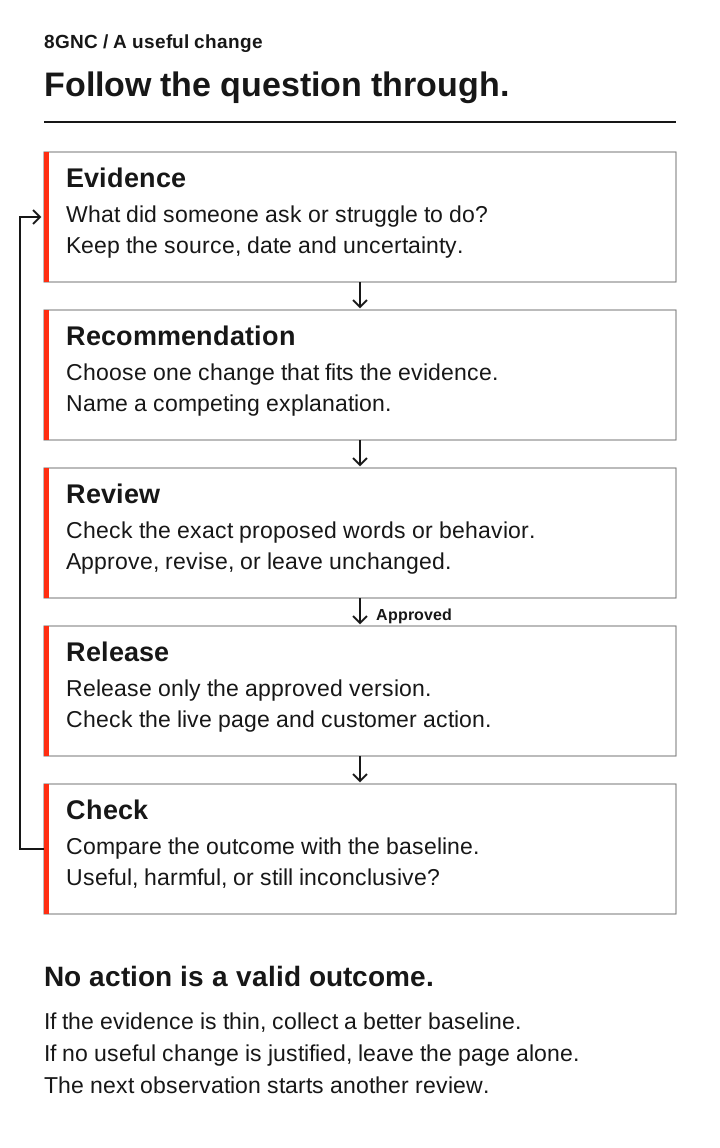
An agentic website combines the site with an ongoing process for finding and preparing useful improvements. Software helps collect and organize evidence. People remain responsible for the brand, the decision and the work that reaches customers.
The evidence might come from search queries, questions customers ask, a broken form, a confusing offer or an article whose advice has become outdated. The response might be a clearer paragraph, a better proof example, a technical repair or a new guide.
The important question is why that particular change deserves attention.
Give every proposed change a reason
For the implementation example, the recommendation should be understandable without an analytics presentation:
“Customers are asking whether implementation is included. The current service page describes the strategy but leaves the delivery boundary unclear. We recommend adding an accurate scope explanation and a relevant project example.”
That is enough to start a useful review. You can correct the premise, refine the scope or approve the work. You can also decide the evidence is too thin.
This is an illustrative example, not a reported client result. In actual work, the recommendation should point to the evidence that produced it and protect any customer information involved.
Make the review concrete
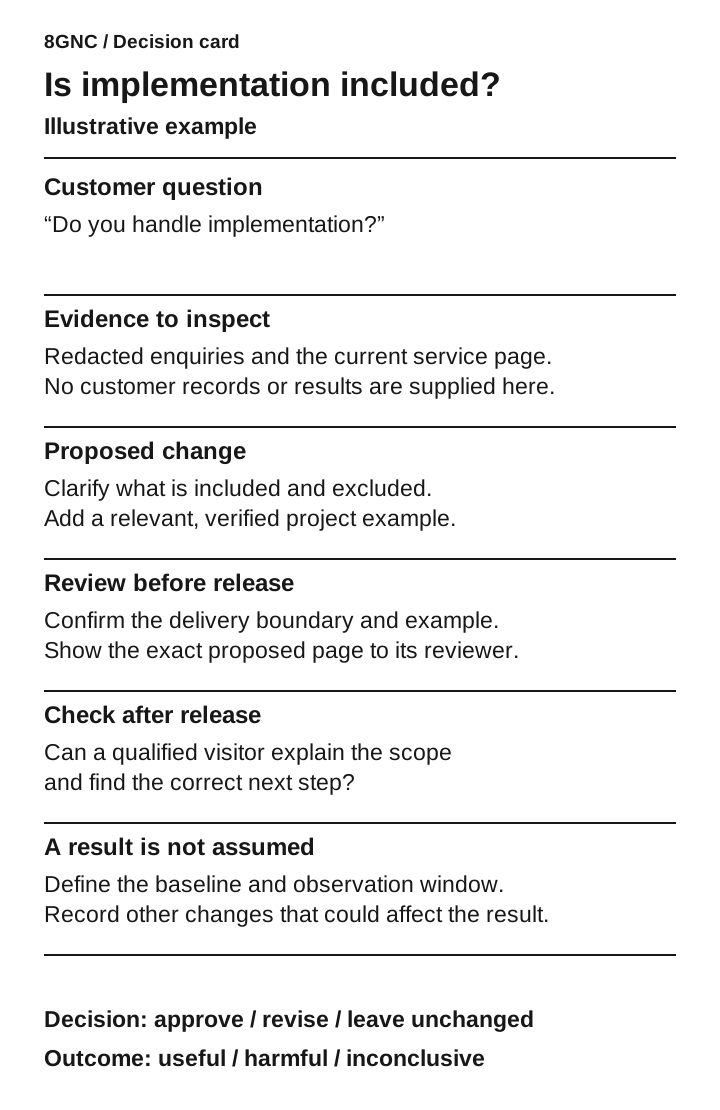
An approval request should show the proposed words or behavior. It should explain what will change and which facts need confirmation.
For a service page, that may mean a short preview with the scope paragraph, the proof example and the next-step link. For a technical repair, it may mean the affected behavior and the checks that show it works.
“Improve conversions” is a goal. It is not a reviewable change.
The approved version should then travel through the site's established release process. Once it is live, someone should check the actual page and the customer action. A completed draft or successful build is not the same as a working public experience.
Check the result that matters
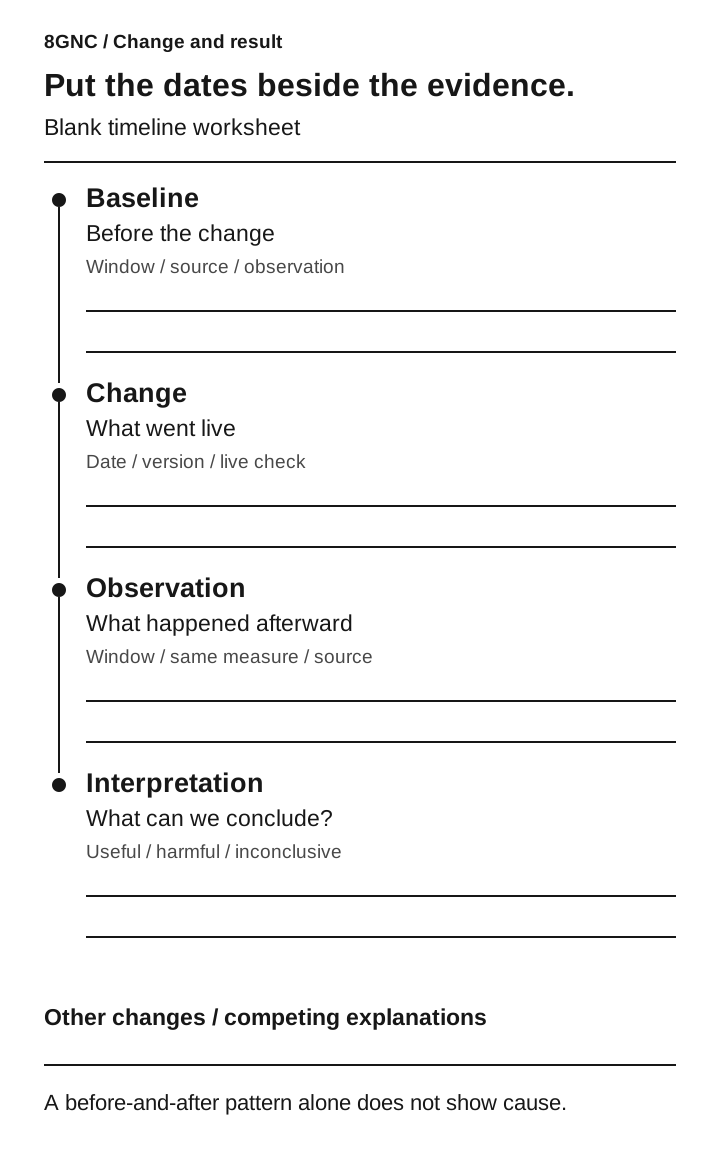
Return to the original problem. Do qualified customers understand what is included? Does the same question still arrive? Can they find the relevant example and contact the right person?
Search exposure and visits can help explain what happened, but they do not answer every business question. More traffic may bring more unsuitable enquiries. Fewer enquiries may reflect clearer qualification rather than a worse website.
The measurement needs a reasonable window and enough evidence to support a conclusion. Other changes in the business or market can affect the result. Sometimes the honest answer is that we cannot tell yet.
That answer should appear in the operating view, too.
Useful content is part of the same process
When a customer question is bigger than a paragraph, it may deserve a guide. When an existing guide contains outdated advice, it needs a correction. A news story matters when it changes something the reader needs to understand or do.
The goal is a library that helps customers make better decisions. A busy publishing calendar does not establish that the content is useful.
Each article should have a clear audience, a question it resolves, supporting evidence and a next step. Related articles should work together instead of competing to give the same answer.
Decide what to connect before deciding what to automate
A local shop, a construction firm and an advisory business need different kinds of evidence. Their customers take different next steps. Their review responsibilities differ, too.
Begin with the business goal, the current site and the information you can actually trust. Agree on who reviews the work, what the ongoing service includes and how results will be evaluated. Then connect the sources that help with those decisions.
A useful starting point is one page, one recurring customer question and one change you can explain.
Bring us that page and the question people keep asking. Talk it through with Michael. We can help work out whether the answer belongs in the copy, the proof, the experience or somewhere else in the business.
A change request you can actually review
Use this on one page before commissioning a larger project. It works in a document or a conversation; no specialist dashboard is required.
| Question | Illustrative entry |
|---|---|
| What happened? | Qualified prospects asked whether the service includes implementation. |
| Where is the evidence? | An anonymized summary of the questions, the dates and the page those people saw. Do not copy private emails into public material. |
| What else could explain it? | The proposal or salesperson may be describing a different scope. Check those before rewriting the page. |
| What should change? | Add an accurate scope paragraph and one permitted example beside the service description. |
| Who checks the facts? | The person responsible for delivering that service. |
| How do we know the change shipped? | Read the live page and test its next-step link on a phone and a desktop. |
| What would count as useful? | Fewer scope misunderstandings among the enquiries we can assess, without hiding limitations from prospective customers. |
| When do we look again? | Agree a date using the business's enquiry volume and sales cycle. Record it before release. |
| What if the result is unclear? | Keep collecting comparable evidence; do not report success solely because the edit is live. |
This is a proposed working method, not a report of a completed 8GNC customer result. The example uses no measured outcome. The sources connected, work included and review cadence belong in the actual service agreement. A website build does not include indefinite monitoring or monthly production by default.
The website and digital-experience service explains how to scope the work. For a problem further along the journey, use From a website visit to a qualified enquiry. For questions about how assistants describe the business, start with the AI visibility guide.
Choose the next useful change
Use the HTML edition to fill in the worksheet. The PDF is a static, untagged print edition.
Get More Like This
Join the 8gnc Dispatch for unfiltered marketing insights.