
STRATEGY · 10 skills
Put your brand strategy into words.
For a business whose team describes the offer differently each time. Work toward a draft strategy report with positioning, cited evidence, assumptions, and an implementation roadmap to review.
Installs in Claude Code. The commands do not run in an ordinary Claude browser chat; your app may have separate charges.

Brandprint Engine produces a structured Brand Strategy & Competitive Positioning Report with cited research, positioning tested against named competitors, and the white space the evidence supports. It is a methodology and drafting aid, not a substitute for accountable human judgment. Free and MIT-licensed, public on GitHub.
Setup in Claude Code
The install commands below run in Claude Code, a separate app from Claude in your browser. You need access to that app before installing; its account and plan requirements are separate. The skill files are open, but importing them into another app depends on that app’s support. Install once, own the files. MIT-licensed. Updates ship free through /plugin update.
Produces a structured Brand Strategy & Competitive Positioning Report with cited research, explicit assumptions, and an implementation roadmap. PDF and HTML output.
- ▸Researches 800+ sources automatically
- ▸Tests your positioning against named competitors
- ▸Tells you if you collide — and where the open space is
- ▸Outputs a client-ready report with implementation roadmap
How it works
What’s in the box · 10 skills
brandprint-engine-guide
The operator's manual — what order to run everything, what each layer feeds the next, where to start.
core-human-truth
Layer 1. Researches your audience until it lands the one truth your whole strategy stands on — the thing customers feel but nobody's saying.
brandprint-tier-a
Layer 2. The structural elements: brand architecture, equity ladder, signature-offer mapping, the economic engine behind the positioning.
brandprint-tier-b
Layer 3. The behavioral layer: brand voice, tone and manner, guardrails and no-no's — then it tests brand behavior against them.
brandprint-tier-c
Layer 4. The expression layer: mantra, personification, features-to-benefits translation, finished brand copy.
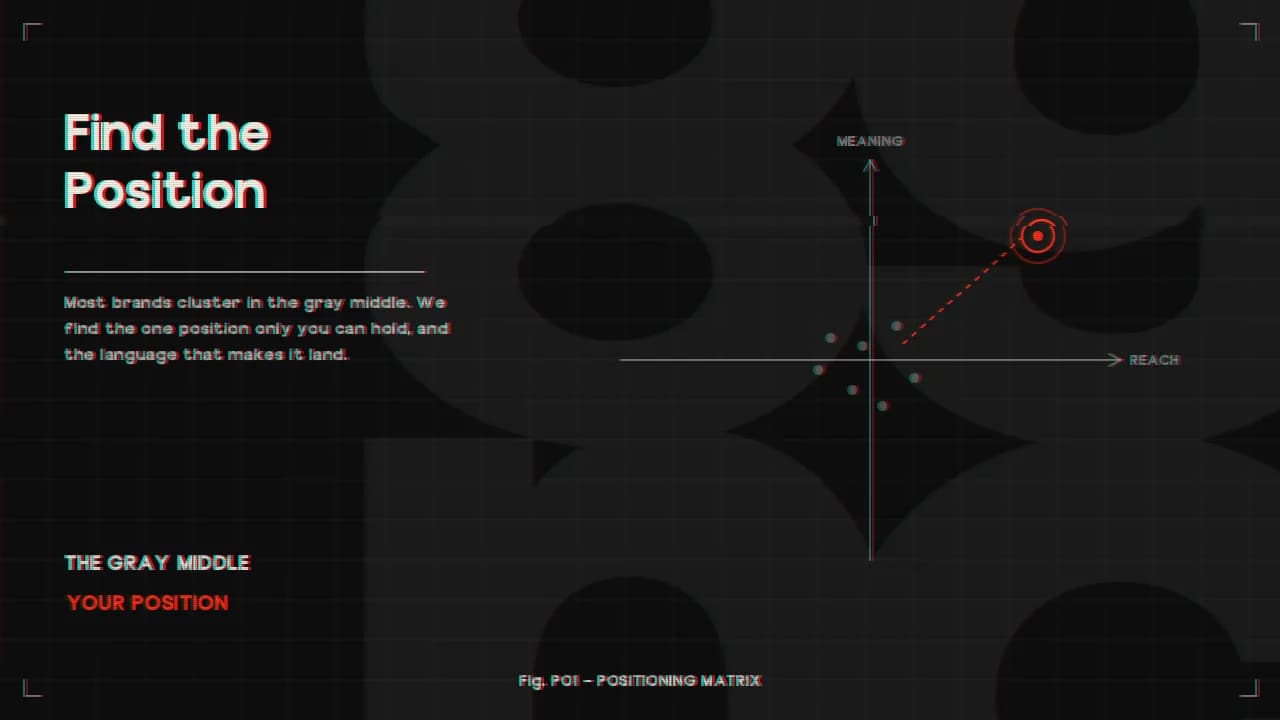
competitive-positioning-audit
Layer 5. Stress-tests your positioning against named competitors and flags every collision before the market does.
competitive-teardown
Category-level white-space analysis — structural gaps across the whole category, not just brand-vs-brand.
brand-revival
For stale or invisible brands: what died, what's salvageable, and the repositioning path back to relevance.
deep-research
The research engine under all of it — multi-source, citation-tracked, verified. This is where the 800+ cited sources come from.
brand-strategy-compiler
Layer 6. Compiles every layer into the client-ready 30+ page report — PDF and HTML, full bibliography included.
Sample output
What the report ships with — 11 sections, every claim sourced.
- 01Executive Summary
- 02Market Context & Category Dynamics
- 03Core Human Truth & Buyer Psychology
- 04Competitive Landscape & White Space
- 05Target Segments & Buyer Archetypes
- 06Brand Architecture & Equity Framework
- 07Competitive Moat Analysis
- 08Signature Offers & Growth Strategy
- 09Brand Activation System
- 10Strategic Guardrails
- 11Implementation Roadmap (24 months)
Questions
How long is the report?
30+ pages, PDF and HTML, with a full bibliography of the 800+ sources it researched. A SessionStart hook warns if Python or weasyprint is missing, and a PostToolUse hook auto-validates the final report against the deliverable contract before you ship it.
How is this different from a consulting engagement?
It gives you a repeatable method and a structured draft: brand architecture, equity ladder, competitive moat, signature offers, and a 24-month roadmap. A human still owns the evidence, tradeoffs, decisions, and implementation.
Does it need a paid research API?
No. The research runs on Claude's built-in web search by default — no extra account. Power users can optionally install the open-source search-cli and bring their own Brave / Serper / Exa keys for deeper multi-source pulls, and weasyprint (a free local install) renders the PDF. None of that is required to produce the report.
Why is it free?
It's the method we run on paid brand engagements, open-sourced. The plugin is the methodology; the agency is the hands. Run it yourself, or call us when you want it run for you.