# Get chosen. Stay chosen.
Canonical webpage: https://8gnc.io/construction-marketing-guide
Updated: 2026-10-12
Commercial construction marketing guide
# Get chosen. Stay chosen.
Win consideration for the work you want. Give buyers a reason to choose you.
A free guide to connecting your marketing, project proof and estimating handoff—so the next opportunity has somewhere useful to go.
[Get the free guide](https://8gnc.io/construction-marketing-guide#guide)[Explore the upcoming webinar](https://8gnc.io/construction-marketing-guide#webinar)
Construction footage with three illustrative guide prompts: check project fit before pursuing a bid, show useful project proof, and prepare an estimate-ready handoff. These are prompts, not live project notifications.

The complete guide, with nine practical worksheets.
Free construction marketing guide
## Better-fit work. A clearer path.
Start with one project you would like to win again.
- Define the projects worth pursuing.
- Turn completed work into useful buyer proof.
- Make your website and follow-up support the next conversation.
- Give estimating the context it needs to proceed.
37 pages · Nine practical worksheets · PDF
[Download the free guide](https://8gnc.io/resources/construction-guide/v13/get-chosen-stay-chosen.pdf)
No signup required. Read it with your team or work through one worksheet at a time.
Also included: an editable proposal template. [See the bonus](https://8gnc.io/construction-marketing-guide#proposal-bonus)
[Read online](https://8gnc.io/construction-marketing-guide#guide-reader)
A bonus to put it into practice
## An editable proposal template.
Use what you work through in the guide to build a clearer proposal. Start with an editable presentation for PowerPoint and Keynote, then add your identity, project photographs and the details the buyer needs.
PowerPoint + Keynote · 14 editable proposal slides + setup
[Get the guide + bonus template](https://8gnc.io/downloads/construction-proposal-template-and-guide.zip)
4.9 MiB ZIP · No signup required.
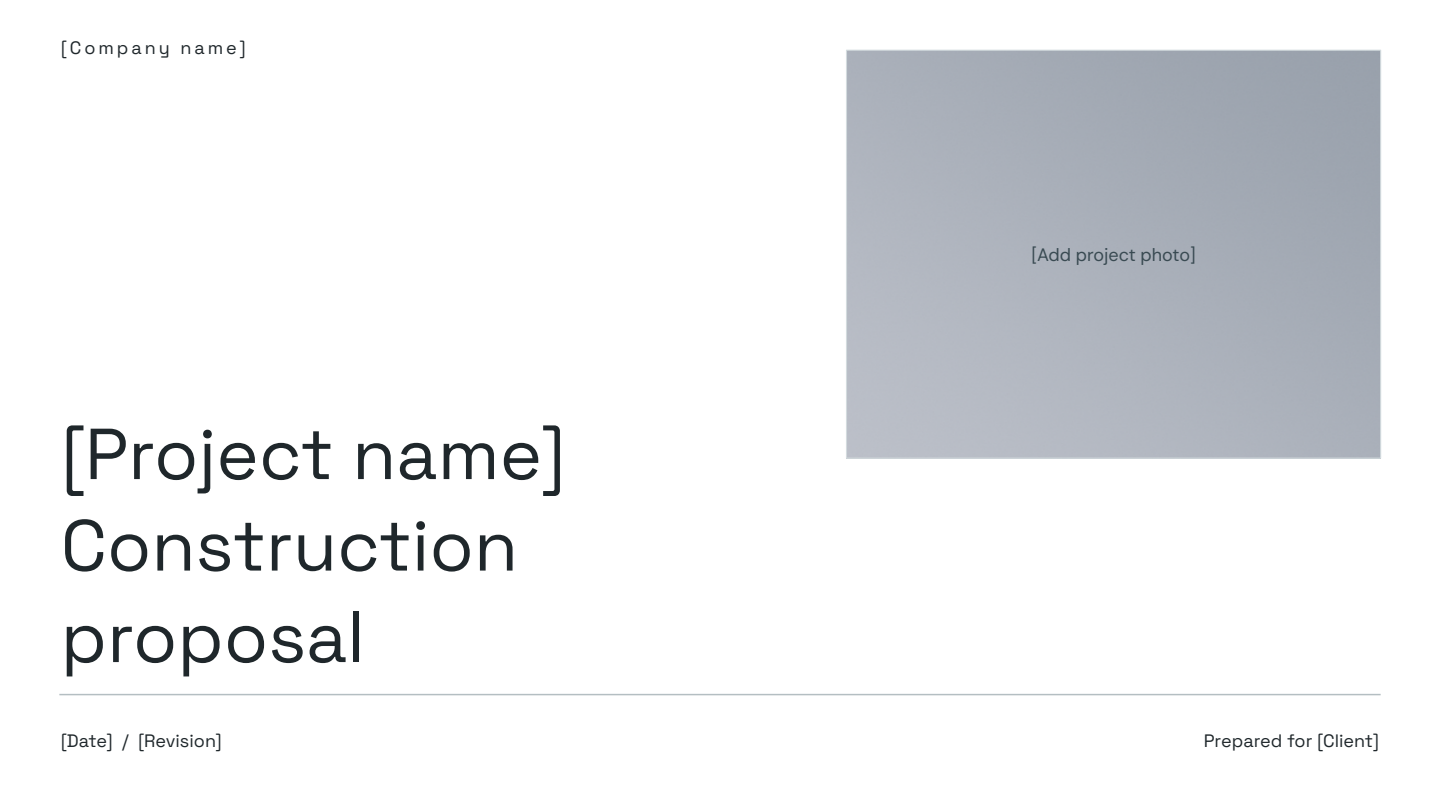
Actual template preview. Add your own project photos.
Look inside the bonus template
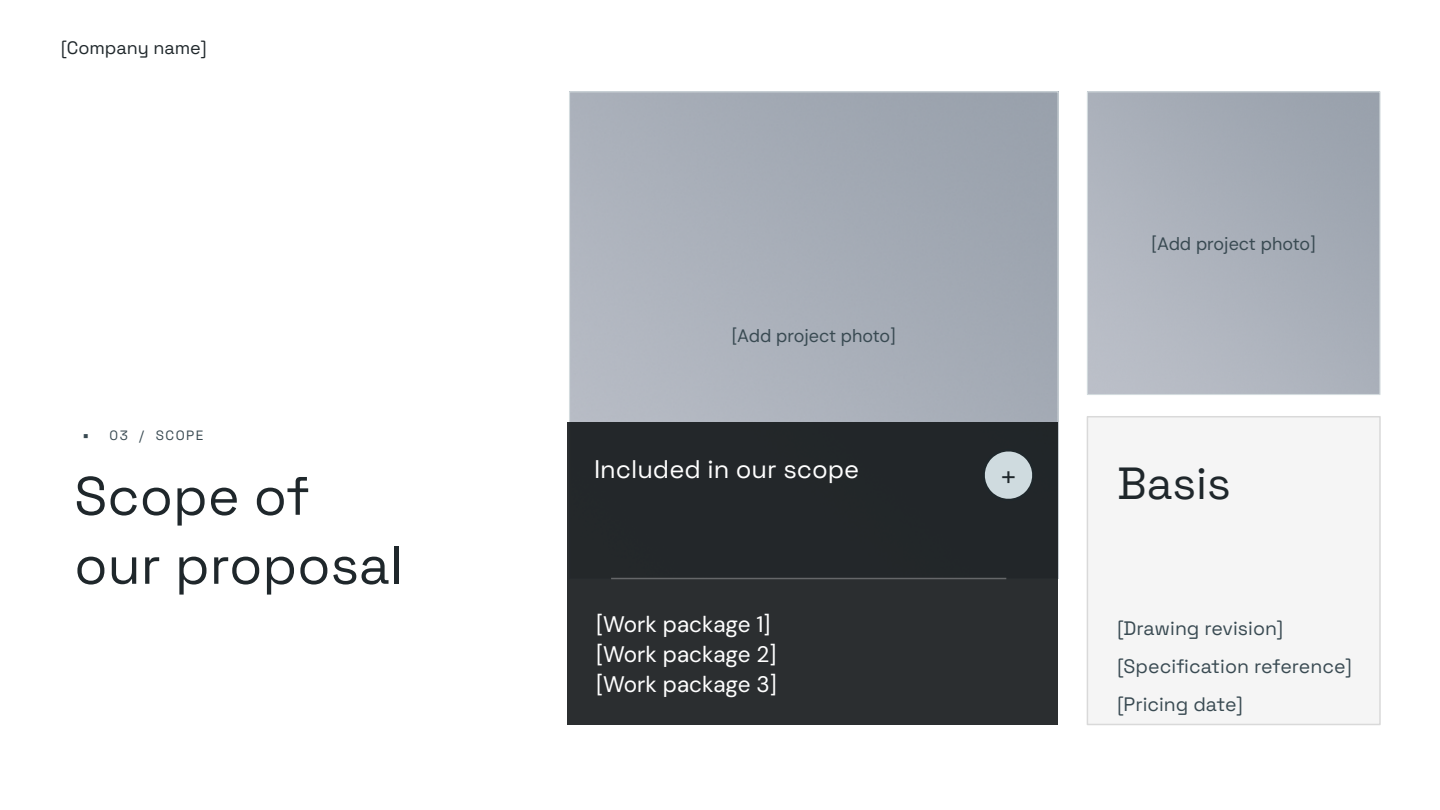
Scope
Pricing
- 14 proposal slides + one removable setup slide
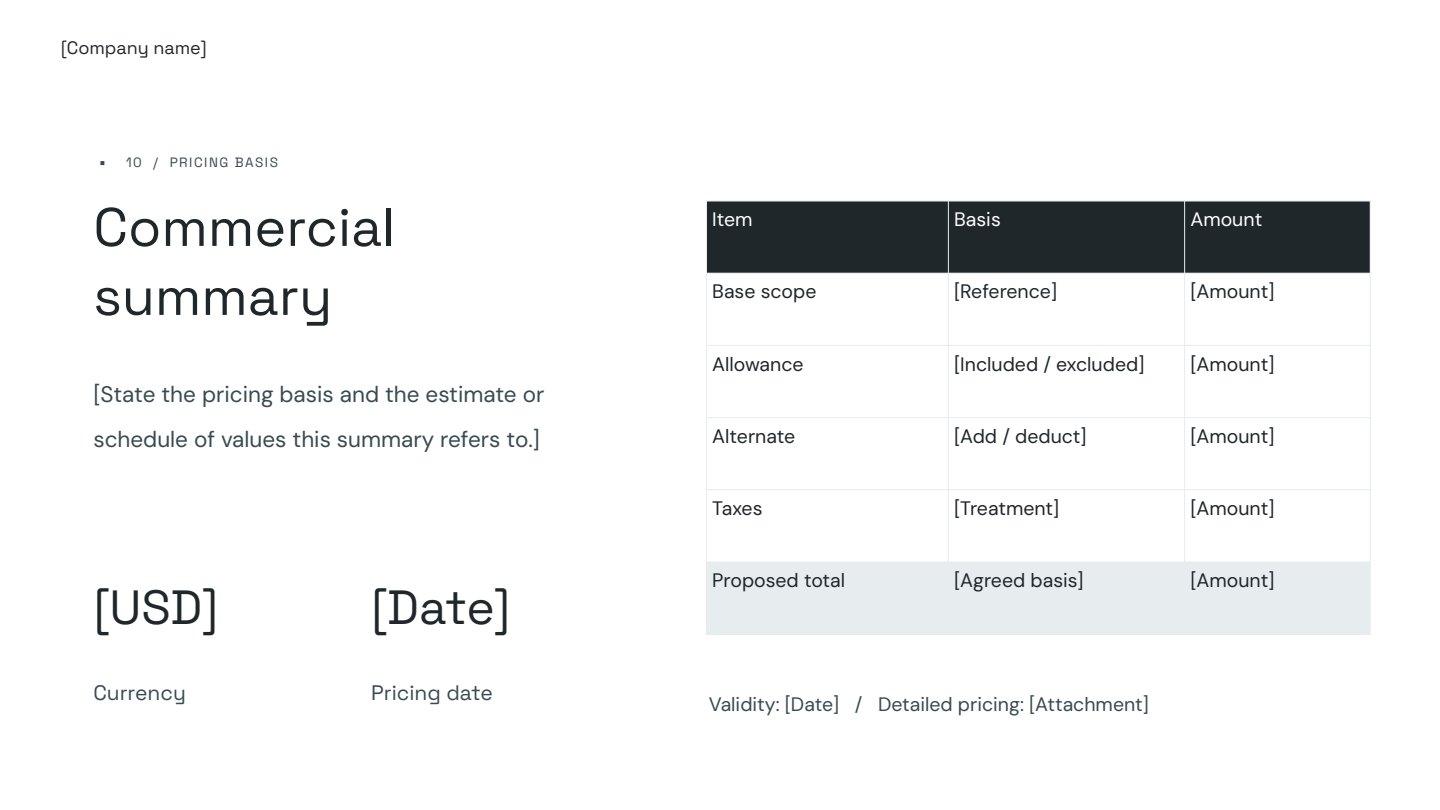
- Editable milestone and pricing tables
- PowerPoint, Keynote and a proposal PDF preview
- Setup instructions, fonts and font licenses
- Get chosen. Stay chosen.: 37 pages, nine worksheets
- Project photographs are not included.
A construction proposal explains your understanding of the job, approach, scope, team, schedule and price. This template gives commercial contractors an editable presentation structure in PowerPoint and Keynote.
Download the ZIP. Make the template yours. Use the guide to sharpen what goes inside.
### Questions about the bonus.
What is in the download?
The editable PowerPoint and Keynote template, a PDF preview, setup instructions, fonts and Get chosen. Stay chosen. The template has 14 proposal slides and one setup slide to remove before sharing.
Can I use my own branding?
Yes. Replace the company name, logo, fonts and colors, then add your own approved project photographs. The proposal pages use a neutral design so you can adapt them to your company.
Is this an estimating spreadsheet or construction contract?
It is a proposal presentation. Scope text and the milestone and pricing tables are editable, but they do not calculate an estimate or supply contract terms. Add the detailed documents your project requires.
Who is it for?
Commercial contractors preparing a project proposal or discussing a negotiated opportunity. If a buyer supplies a required response format, follow that format and use only the sections that fit.
How does the guide help?
Get chosen. Stay chosen. looks at the work around the proposal: choosing suitable opportunities, showing relevant experience and handing information to estimating. It is included alongside the template, with nine worksheets.
Construction marketing webinar · Coming soon
## Turn good work into your next opportunity.
Bring the guide into a real business conversation.
A practical conversation about the projects you want, the proof buyers need and the handoff that keeps an opportunity moving.
For commercial contractors, business development teams and the people receiving the next inquiry.
[See what we’ll cover](https://8gnc.io/construction-marketing-guide#webinar-updates)
Date to be announced. Registration is not open yet.

From the first conversation**to a workable handoff.**
Inside the guide
## Good work needs useful proof.
The guide draws on construction discovery, brand strategy and search research. These are practical decisions to work through with your team.
Fit
### Fit comes before pursuit.
Before pursuing a bid, check the project type, territory, estimating time and delivery capacity against the work your firm wants.
[Open the matching worksheet](https://8gnc.io/resources/construction-guide/v13/get-chosen-stay-chosen.pdf#page=29)
Proof
### Give project photos useful context.
Explain your exact role, the constraint you handled and what happened. Use approved facts and imagery; keep unsupported results out.
[Open the matching worksheet](https://8gnc.io/resources/construction-guide/v13/get-chosen-stay-chosen.pdf#page=31)
Handoff
### An invitation is not an estimating brief.
Record the scope, current plan set, due date, open assumptions and receiving owner. Give the estimator a way to accept the handoff or ask for clarification.
[Open the matching worksheet](https://8gnc.io/resources/construction-guide/v13/get-chosen-stay-chosen.pdf#page=34)
Keep the work moving
## Start with a useful question.
A few more ways to look at the decisions in front of you.

### From a website visit to a qualified inquiry
Check where the buyer’s path breaks: explanation, proof, contact or follow-up.
Read the article

### Make your evidence useful enough to cite
Keep the claim, its source and its limits clear when publishing project evidence.
Read the article

### What should your website change next?
Take one customer question through a proposed change, review and a check of the live result.
Read the article
## Questions about the guide
What is included in this free guide?
Get chosen. Stay chosen. is a free, 37-page commercial construction marketing guide from 8gnc, with workflow contributions from br8n. It includes nine printable worksheets covering project fit, buying paths, project proof, discoverability, relationships, estimating handoffs, assisted work, measurement and a 90-day sequence.
What is commercial construction marketing?
Commercial construction marketing helps owners, developers and other buyers understand where a contractor fits and why its experience matters. It connects project evidence, websites, business relationships and follow-up so the right people can evaluate the firm and take a useful next step.
How do I create a construction marketing plan?
Start with the work you want and the capacity available to estimate and deliver it. Map a real buying path, identify the proof buyers need, and choose one constraint to improve. Record a baseline, an owner and a review date before expanding the plan.
How can contractors attract better-fit projects?
Define the project types, buyers, geography and delivery constraints that fit your business. Show relevant completed work, explain the challenges your team handled, and make the inquiry route clear. Keep qualification and bid/no-bid decisions connected to actual estimating and delivery capacity.
What should a construction company website include?
A useful construction website explains what the firm builds, where it works and whom it serves. It connects relevant project studies to its capabilities and provides a clear inquiry route. Buyers should be able to inspect useful evidence and reach the right person.
Upcoming construction-marketing webinar
## Put the guide to work.
Our upcoming webinar will connect the ideas to everyday decisions.
- Choose the work worth pursuing.
- Make completed projects easier for buyers to evaluate.
- Connect the inquiry to an estimate-ready handoff.
Webinar updates
### Be part of the conversation.
Dates and registration details are coming. In the meantime, you can download the guide and start with one worksheet.
Email address
Registration is not open yet. No email is collected here.
# Get chosen. Stay chosen.
## A commercial construction marketing guide to better-fit work
**An 8gnc.io guide, with workflow contributions from br8n.io**
October 2026
Construction growth depends on more than being found. Buyers need a reason to consider your company, evidence that you can handle their project, and a dependable way to keep the conversation moving.
This guide connects those jobs. It is for commercial general contractors and specialist firms pursuing work through owners, developers, brands, architects, and existing relationships. Residential contractors can use the planning tools, but the examples and sales process here address commercial buying.
The recommendations come from our construction discovery work, search analysis, brand strategy, and operating experience. They are proposed practices, not promises of increased revenue. Client-identifying details and confidential performance data are not included. [1] [2]
**Research context.** BuildOps' vendor-published survey of 606 respondents, conducted August 12-21, 2025, separates firms already using AI (16%) from those testing it (62%). Combining the groups does not establish routine deployment or results. Its trade-focused sample and inconsistencies in the geographic eligibility description limit generalization. Use it as dated context for checking readiness, training and ownership, alongside your own records. [12]
## Start with the work you want
A contractor can have a full calendar and a fragile business. A familiar customer may account for much of the pipeline. An estimator may be pricing projects the firm should decline. A website may attract job seekers and project-name searches while providing little evidence that unfamiliar buyers are considering the company.
Treat marketing as a way to improve the quality and continuity of opportunity. That includes being discovered, being evaluated, being invited to the right conversations, and maintaining relationships after a project ends. SMPS describes business development in A/E/C as identifying clients and opportunities, developing relationships, and securing profitable work. That is the business context for this guide. [3]
Start by reviewing your last ten awarded projects and ten bids that did not become work. Record where each came from, who influenced the decision, what your team spent pursuing it, and what made it suitable or unsuitable. Where job-cost records are available, compare estimated and actual contribution. Where they are missing, mark the gap instead of substituting an industry average.
An annual revenue target is useful, but it does not tell you whether the next project is a good choice. Add the constraints that affect delivery: available people, estimating hours, working capital, geography, subcontractor coverage, schedule, and the complexity your team can handle. An opportunity is valuable only in the context of those constraints.
### Protect the capacity you are trying to sell
A better-fit opportunity still needs people who can estimate, mobilize and deliver it. Before increasing demand, ask where the team is already stretching: scope review, supplier questions, site supervision, documentation or the transfer from a successful bid into delivery. A shortage in one role may change which projects are sensible to pursue, even when the overall pipeline looks healthy.
BuildOps’ August 2025 contractor survey raises staffing pressure and operational complexity alongside technology adoption. Those findings provide questions to investigate in your own business; they do not establish your staffing position or the value of buying software. [12]
Use the capacity entry in Worksheet 1 to record the constraint you can verify. Then make it visible in the bid/no-bid conversation. Marketing should help the right opportunity reach a team prepared to handle it.
Our construction conversations suggest a useful question: **What would make the next project easier to pursue, safer to accept, and more likely to lead to repeat work?** This is a diagnostic question, not a description of every contractor's problem. [1]
### Worksheet 1: define better-fit work
| Decision | Your answer |
| --- | --- |
| Priority project type and buyer | __________________________________ |
| Geography and delivery territory | __________________________________ |
| Project size, schedule, and constraints | __________________________________ |
| Evidence that this work is profitable for us | __________________________________ |
| Capacity available to estimate and deliver | __________________________________ |
| Conditions that make us decline | __________________________________ |
| One commercial measure to improve | __________________________________ |
| Current baseline, source, and review date | __________________________________ |
If you have a measured win rate for comparable qualified bids, use it to plan the required bid pipeline. Ten additional awards at a 25% qualified-bid win rate would require forty comparable qualified bids. This is a fictional arithmetic example. It excludes differences in project value, timing, repeat work, and capacity; it is not a forecast.
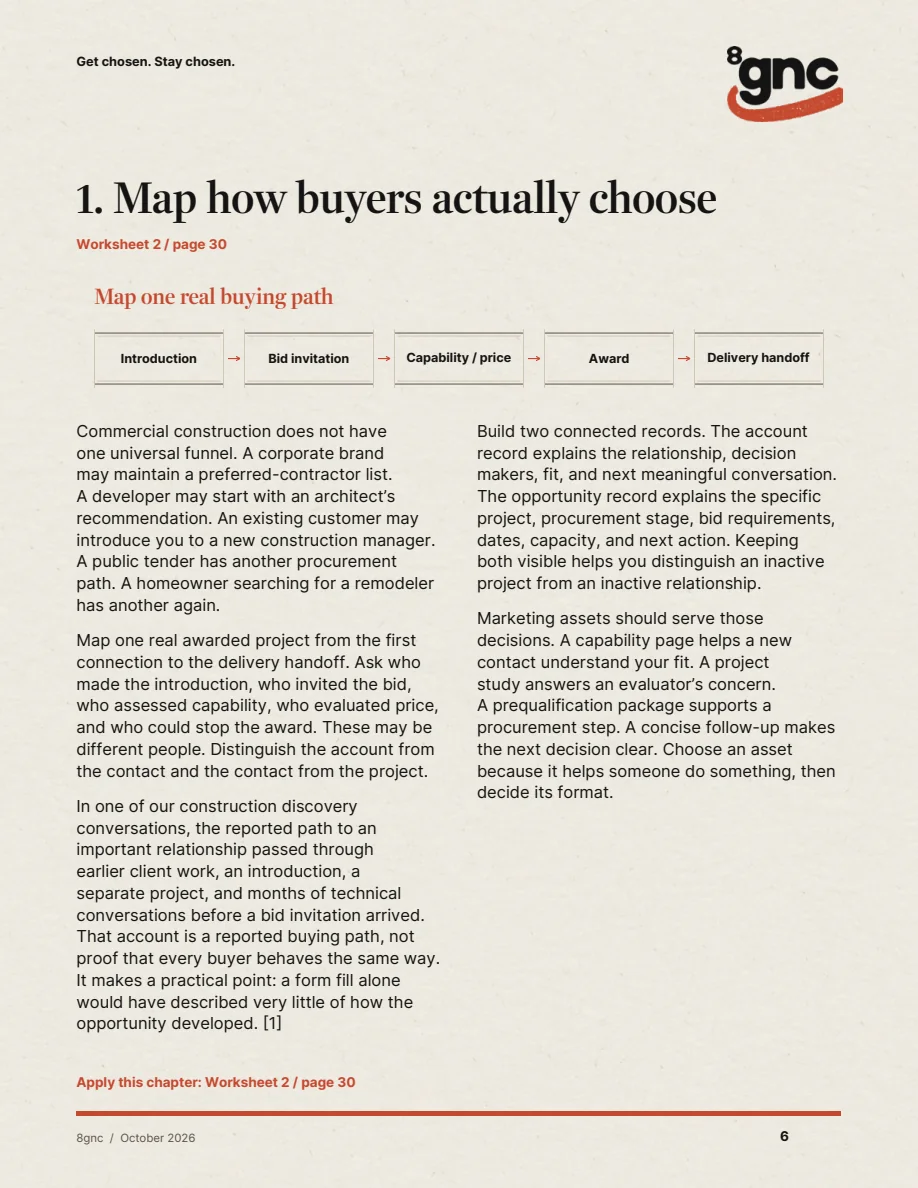
## 1. Map how buyers actually choose
Commercial construction does not have one universal funnel. A corporate brand may maintain a preferred-contractor list. A developer may start with an architect's recommendation. An existing customer may introduce you to a new construction manager. A public tender has another procurement path. A homeowner searching for a remodeler has another again.
Map one real awarded project from the first connection to the delivery handoff. Ask who made the introduction, who invited the bid, who assessed capability, who evaluated price, and who could stop the award. These may be different people. Distinguish the account from the contact and the contact from the project.
In one of our construction discovery conversations, the reported path to an important relationship passed through earlier client work, an introduction, a separate project, and months of technical conversations before a bid invitation arrived. That account is a reported buying path, not proof that every buyer behaves the same way. It makes a practical point: a form fill alone would have described very little of how the opportunity developed. [1]
Build two connected records. The account record explains the relationship, decision makers, fit, and next meaningful conversation. The opportunity record explains the specific project, procurement stage, bid requirements, dates, capacity, and next action. Keeping both visible helps you distinguish an inactive project from an inactive relationship.
Marketing assets should serve those decisions. A capability page helps a new contact understand your fit. A project study answers an evaluator's concern. A prequalification package supports a procurement step. A concise follow-up makes the next decision clear. Choose an asset because it helps someone do something, then decide its format.
### Worksheet 2: one real buying path
| Step | Person or role | Evidence needed | Owner and next action |
| --- | --- | --- | --- |
| First awareness or introduction | __________ | __________ | __________ |
| Capability evaluation | __________ | __________ | __________ |
| Qualification or approved-list entry | __________ | __________ | __________ |
| Bid invitation and bid/no-bid | __________ | __________ | __________ |
| Estimate, clarification, and selection | __________ | __________ | __________ |
| Contract and delivery handoff | __________ | __________ | __________ |
| Next project or relationship review | __________ | __________ | __________ |
Check the map with the people who did the work. A process drawn from a software demo is still an assumption until it matches a real project.
## 2. Turn completed work into useful proof
A gallery shows what a project looks like. A buyer evaluating your firm also needs to understand what you were responsible for, what made the work difficult, how the team handled it, and whether the experience applies to their situation.
Choose two or three projects that demonstrate the work you want next. A large project is not automatically the best example. A relevant constraint, such as working around an occupied building or repeating a brand standard across locations, may make a smaller project more useful to a particular buyer.
For each study, document the project type, location, completion period, client-approved scope, your exact role, and one meaningful constraint. Explain the decisions your team made. Describe the result only as precisely as the source permits. If the owner has not approved budget, schedule, performance, or photography for release, omit those details until cleared.
Our historical construction strategy work connected differentiation to continuity, institutional memory, and experience with complexity. The lesson is to show how the team earns confidence through its work. Ownership structure, awards, and tenure can support that argument when verified; they do not replace the project evidence or justify an absolute certainty claim. [2]
Create one maintained source for each project study. Reuse its approved facts on the website, in a capability statement, in a proposal, and in a salesperson's follow-up. Record who can update it and when it was last checked. This keeps a hurried proposal from introducing a project count or outcome the website team cannot substantiate.
### Put the people’s judgment into the proof
Ask the people closest to a completed project which decision another buyer would find useful. A superintendent might explain how access was maintained. An estimator might identify the scope assumption that needed resolving. A project manager might describe how the team kept the owner informed when conditions changed. These are interview prompts, not claims about a particular project.
Turn one verified account into a short explanation of the situation, your responsibility and the decision made. Pair it with a permitted photograph or record when that evidence helps. Give the contributor a chance to correct the account, and obtain the relevant client and media permissions before release.
Brandwatch’s 2026 trends report highlights employee voices and original creative work. For a contractor, the useful test is whether firsthand expertise answers a real buyer question. [16] Try one proof card with an appropriate contact. Record what became clearer and what remained unresolved before commissioning a larger content program.
### Worksheet 3: the project proof card
| Field | Record |
| --- | --- |
| Project and relevant buyer question | __________________________________ |
| Our exact role and contracted scope | __________________________________ |
| Constraint the team had to manage | __________________________________ |
| Decision or method used | __________________________________ |
| Observed result and supporting record | __________________________________ |
| Client, photographer, and other permissions | __________________________________ |
| Approved wording and unavailable details | __________________________________ |
| Owner and next verification date | __________________________________ |
Try the card in a real sales conversation. Ask which question it answered and which question remained. Do not measure its usefulness only by page views.
## 3. Make your website help the buyer decide
A commercial contractor's website can support discovery, evaluation, recruiting, vendor relationships, and ongoing client reassurance. Those visitors need different routes. A rise in total traffic does not tell you which route is working.
Start with a clear description of the firm: what it builds, where it works, who it serves, and why its experience matters. Link priority capabilities to relevant project studies. Make it easy to find the people and process involved in a first conversation. Give employment and vendor inquiries their own destinations so they are not reported as buyer opportunities.
A useful capability page answers five questions: Is this the work you do? Have you handled a comparable constraint? Can you work in the required territory? What evidence can I inspect? What happens if I contact you? A project inquiry form should request enough information to route the opportunity without asking an unfamiliar visitor to complete an entire bid package.
Repair the current site when that can solve the problem. Rebuild when the structure, editing process, performance, accessibility, or maintenance burden makes repair impractical. Compare those options against the actual site and the pages that already attract useful searches. Preserve worthwhile URLs and plan redirects before replacing them.
Technical work should support the content. Check crawl access, index eligibility, canonical URLs, internal links, mobile usability, readable text, image delivery, and working inquiry paths. Structured data should describe what the visitor can actually see. Technical eligibility creates the possibility of visibility; it does not guarantee indexing or ranking. [4]
### A small, useful first website package
| Asset | Job it performs | Acceptance check |
| --- | --- | --- |
| One priority capability page | Explain fit to the intended buyer | Buyer can identify service, territory, proof, and next step |
| Two verified project studies | Demonstrate relevant experience | Facts and permissions checked against source records |
| One practical decision resource | Help the buyer prepare | User can complete a useful task without a sales call |
| One inquiry route | Start a suitable conversation | Submission reaches the named owner with usable context |
| Measurement and routing | Connect visits to opportunities | Controlled test produces an actual record and receipt |
The last check requires a completed test. Seeing a success screen does not establish that an email arrived, a record was created, or a person accepted responsibility.
## 4. Engineer discoverability around decisions
Search research should connect buyer language to useful evidence. Begin with your own Search Console queries and pages, then add customer interviews, sales questions, project records, and provider estimates. Each source answers a different question. Search Console measures your site's recorded search performance; a keyword provider estimates activity in a wider market. Neither identifies a qualified buyer by itself. [5] [6]
Build a matrix of buyer, project type, constraint, geography, and decision. For a restaurant contractor, that might include the corporate construction team, a repeated store format, site readiness, a supported territory, and the choice of a rollout contractor. For an adaptive-reuse firm, the relevant problem may be unknown building conditions and the choice of a preconstruction partner. Validate the words with actual customers.
Inspect the search results before selecting a target. Does the phrase return contractor services, software, jobs, academic material, or homeowner advice? An attractive volume estimate can belong to the wrong audience. In our current research, broad construction-marketing terms had more reported demand than the narrower commercial phrase; several exact workflow phrases had no reported estimate. Missing estimates are not evidence of an empty market. [7]
Use four connected content types. A capability page explains what you do. A project study provides evidence. A decision resource helps the buyer perform a task. A short expert explanation answers a specific question and connects to the other three. That is a usable cluster; it does not require dozens of interchangeable location pages.
DataForSEO can help estimate demand and inspect live search results. Preserve the phrase, geography, language, device, date, requested depth, actual returned sample, and API status. Advertising competition and CPC describe the paid-data context; they are not organic ranking difficulty. Do not add close-variant volumes into a market-size claim. [7]
Prioritize a page only when you can explain its buyer, decision, proof, and destination. If a topic matters commercially but has little measured search activity, use it in account conversations, partner introductions, workshops, or follow-up. It may deserve a useful section within a broader page before it deserves its own indexed URL.
### Worksheet 4: the discoverability brief
| Question | Your answer |
| --- | --- |
| Which buyer is trying to decide what? | __________________________________ |
| Which words do buyers actually use? | __________________________________ |
| What do the current results satisfy poorly? | __________________________________ |
| What original evidence can we contribute? | __________________________________ |
| Which existing page already serves this need? | __________________________________ |
| What resource will help the reader act? | __________________________________ |
| How will we distinguish buyer interest from other visits? | __________________________________ |
| What result would make us revise the hypothesis? | __________________________________ |
## 5. Prepare for AI-assisted discovery
AI-assisted search is another place buyers may encounter your expertise. Keep the underlying facts clear: company identity, capability, geography, responsible author, project evidence, and date. Write the useful answer in visible text and connect it to its source.
Google says its existing SEO fundamentals apply to AI Overviews and AI Mode. It does not require a special AI text file or special schema to appear. Its systems can issue related searches across several subtopics, which makes complete, connected explanations useful without establishing a guaranteed citation formula. [4]
Avoid turning a handful of prompts into a claim about market share. A practical monitoring set should record the exact question, platform, date, location where applicable, answer, cited sources, and whether the company was named. Include prompts that do not mention your company. Repeat the same set to observe changes, while recognizing that answers can vary.
Keep appearance, click, inquiry, and award separate. Google's dedicated generative-AI reports provide an impressions view; that is a visibility measure. In the 2025 Pew study of U.S. browsing behavior, users clicked traditional results in 8% of visits with an AI summary versus 15% without one. That historical general-search finding is not a construction conversion benchmark, but it cautions against equating visible answers with website visits. [8] [9]
Ask prospects how they learned about you and what they reviewed before contacting you. Record their answer alongside attributable visits and inquiry records. A rise in direct traffic or company-name searches may be worth investigating; it does not establish that AI caused the rise.
## 6. Keep relationships useful when people change
Our construction discovery work surfaced a recurring operational question: what happens when a familiar contact changes employer or a new decision maker joins an existing client? The firm may retain its project history while losing the person who understood why that history mattered. This is a reported client concern and a useful hypothesis to test elsewhere. [1]
Maintain the company relationship separately from the individual relationship. Keep current roles, previous roles, relevant projects, promised follow-up, and the basis for the relationship in a company-owned record. When a person moves, verify the change and decide how to reconnect. Reintroduce relevant proof to the incoming contact instead of assuming familiarity transferred with the job title.
### Make the handover usable for the next person
A contact list can preserve names while losing the reason a relationship matters. During an account handover, explain what the customer was trying to achieve, which project established trust, what remains unsettled and what the company has promised to do. Link to the permitted supporting record instead of asking the next person to reconstruct a conversation from scattered messages.
Have the incoming owner describe the next useful action in their own words. If they cannot, clarify the record together. Include someone who understands the work when a technical explanation matters; the new account owner should not have to improvise it.
Allow time for that exchange. Calm Health’s guide connects readiness for change with learning capacity, communication and accessible support. [15] Applied here, that means a practical walkthrough, time to ask questions and a known person to approach afterward. It does not require collecting personal health information. Retain the useful working knowledge while respecting each person’s privacy.
Review valuable accounts on a cadence that matches their project cycle. Some relationships need an immediate project action; others need an occasional useful conversation. The purpose is to remain relevant, understand upcoming decisions, and recognize changes. An automated sequence is not a substitute for knowing why the message should exist.
Choose a short, manageable account list for the first review. For each account, identify who owns it, which relationship is active, what the last useful exchange was, and what would justify the next one. Where information is stale, assign a verification task. Do not populate missing facts with AI guesses.
### Worksheet 5: relationship continuity
| Account | Current decision role | Last meaningful exchange | Next useful reason to reconnect | Owner/date |
| --- | --- | --- | --- | --- |
| __________ | __________ | __________ | __________ | __________ |
| __________ | __________ | __________ | __________ | __________ |
| __________ | __________ | __________ | __________ | __________ |
| __________ | __________ | __________ | __________ | __________ |
Add a continuity check: could a replacement business developer understand this account from the record, and could the company retain the history if the current employee left?
## 7. Connect opportunity to estimating capacity
More inquiries can increase work without improving the business. Before asking for more demand, examine what happens when an opportunity reaches estimating. Does the team know the scope, decision date, buyer, source documents, delivery constraints, and reason to pursue?
Define a bid/no-bid decision using your own economics and capacity. Include strategic fit, buyer access, scope clarity, available estimating time, delivery resources, subcontractor coverage, payment considerations, and the evidence required for a responsible bid. Hard constraints need an explicit decision; a points score should not silently override them.
Keep the decisions separate. A good relationship does not make every project suitable. A bid invitation is not an award. A submitted estimate is not a signed contract. A CRM stage should reflect the evidence required to enter that stage, not optimism about the customer.
Use a handoff that the receiving estimator can accept or return with a specific question. Record versions of plans and assumptions. Keep uncertain items visible. When procurement conditions change, revise the context before sending another number. The goal is to reduce preventable rework while leaving commercial judgment with the responsible people.
### Find the work hiding between the steps
Follow one recent opportunity from the first inquiry to an accepted estimating brief. Ask the people involved to show where they searched for information, copied an answer, checked a version, chased a missing decision or returned a package for clarification. The gaps between systems may be carrying work that never appears as a task.
Superhuman’s Workaround Economy report examines that kind of effort among surveyed professionals. Its findings are a reason to inspect handoffs, not an estimate of the hours your contractor can save. [13] Scribe makes a related distinction: replacing a platform, improving a workflow and automating a task are different changes. Each needs an account of the actual decisions and exceptions. [14]
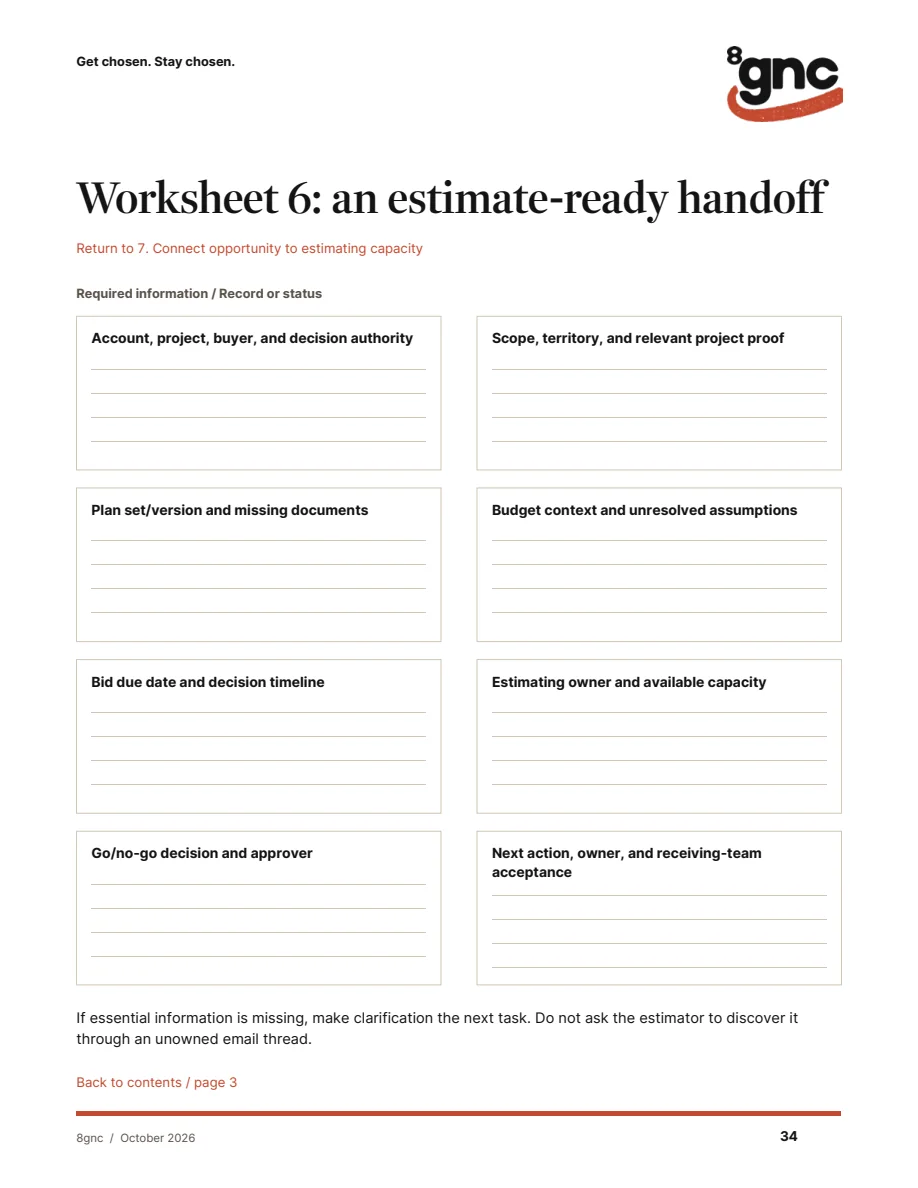
For the handoff you observed, agree what “ready for estimating” requires and who checks it. Make the current plan set, unresolved assumptions and receiving estimator’s acceptance visible in Worksheet 6. If a document is missing, record who will clarify it. If scope changes after acceptance, show what changed and ask the receiving team to reconfirm. A cleaner handoff may be the whole first improvement; automation can be considered once its job is clear.
### Worksheet 6: an estimate-ready handoff
| Required information | Record or status |
| --- | --- |
| Account, project, buyer, and decision authority | __________________________________ |
| Scope, territory, and relevant project proof | __________________________________ |
| Plan set/version and missing documents | __________________________________ |
| Budget context and unresolved assumptions | __________________________________ |
| Bid due date and decision timeline | __________________________________ |
| Estimating owner and available capacity | __________________________________ |
| Go/no-go decision and approver | __________________________________ |
| Next action, owner, and receiving-team acceptance | __________________________________ |
If essential information is missing, make clarification the next task. Do not ask the estimator to discover it through an unowned email thread.
## 8. Use AI where the work can be checked
An internal assistant can help assemble account context, summarize a meeting, identify missing handoff fields, or prepare a follow-up for review. Those are candidate tasks. Each needs source access, a named owner, and a way to check whether it helped.
Start with the present process. Time one recurring task, including preparation, checking, correction, and exception handling. Try the native capabilities of the current tools before adding another system. Where AI is useful, compare the entire task against that baseline rather than comparing only the drafting step.
Define permitted sources and actions. Reading approved account records is different from editing them. Drafting a message is different from sending it. Suggesting a bid priority is different from accepting an opportunity. The assistant should expose missing or conflicting information and route it to the responsible person.
Test ordinary and awkward cases: a contact with the same name as another, an outdated employer, contradictory meeting notes, an incomplete plan set, a changed bid date, a failed connector, and an action whose completion is uncertain. Require the tool to preserve uncertainty and produce a usable manual fallback.
### Include learning in the work plan
Introducing an assistant changes someone’s working day. That person needs to learn which sources it uses, when to trust its output, how to spot an exception and what to do when it fails. Training squeezed around an already full estimating schedule is still work, even if it has no line in the project plan.
For the task in Worksheet 7, agree a practice period that fits the team’s real capacity. Use a permitted, representative example. Let the person doing the work compare the assisted result with the current method, explain a mistake and complete the task manually when necessary. Record the support contact and keep a short, accessible explanation of the fallback.
The acceptance question remains practical: can the team complete the whole task correctly with an effort they can sustain? Include preparation, review, correction and support in the comparison. Keep commercial decisions and permission to send or change records with the responsible people.
br8n's contribution is to make work easier through custom forward-deployed AI engineering. That starts with a defined job and a measurable reduction in effort, then training, maintenance, and client ownership. A persuasive demo alone does not establish that the system works reliably beside the team. [10]
### Worksheet 7: one bounded assistant task
| Design decision | Your answer |
| --- | --- |
| Task and user | __________________________________ |
| Current time and error baseline | __________________________________ |
| Approved sources and record owner | __________________________________ |
| Allowed reads, drafts, and writes | __________________________________ |
| Human decisions and approval boundary | __________________________________ |
| Exception tests and completion evidence | __________________________________ |
| Training, support, and manual fallback | __________________________________ |
| Data export, offboarding, and maintenance owner | __________________________________ |
Proceed only when the whole task becomes more useful or less burdensome. A new tool that creates more checking work may be the wrong intervention.
## 9. Measure the route to better work
Keep three layers visible. Discovery includes search impressions, useful visits, and resource engagement. Evaluation includes relevant conversations, prequalification progress, and bid invitations. Commercial and operating performance includes qualified bids, awards, repeat work, estimating effort, handoff quality, and delivered contribution where measured.
Connect them through records rather than a single attribution label. A relationship may begin with a partner introduction, use a website project study, and develop through several conversations before a bid. Capture the known path and retain unknowns. Self-reported discovery is useful context, not a complete causal model.
Search Console query tables do not contain every query. Privacy filtering and data limits mean their row sums can differ from property totals. Use an unfiltered total request for totals, and label any brand share as a share of the visible classified rows. Separately track recruitment, supplier, client, and project-research intent where evidence permits. [5] [6]
Define measures the team can act on. For instance, count opportunities missing a next action, handoffs returned for clarification, priority accounts without a current verified contact, or estimating hours spent on bids declined late. Agree the definitions and baseline before setting targets.
### Measure whether the handoff became easier
A faster draft can still leave the estimator with more checking. In the working scoreboard, define what counts as an accepted handoff and capture returns for clarification alongside pursuit hours. Keep missing or disputed records visible. A small comparison is useful when the projects, tasks and limits are described honestly; it should not become a savings headline detached from its context. [13] [14]
When a new routine appears useful, ask the receiving person what changed. Check whether work disappeared, moved to another colleague or became easier to inspect. Use that evidence to continue, revise or stop the trial. The purpose is a better path into suitable work, with a team able to carry it forward.
### Worksheet 8: the working scoreboard
| Measure | Definition/source | Baseline | Owner | Review decision |
| --- | --- | --- | --- | --- |
| Qualified buyer conversations | __________ | __________ | __________ | __________ |
| Suitable bid invitations | __________ | __________ | __________ | __________ |
| Estimate-ready handoffs | __________ | __________ | __________ | __________ |
| Pursuit hours per qualified bid | __________ | __________ | __________ | __________ |
| Priority accounts with verified next action | __________ | __________ | __________ | __________ |
| Awards and repeat work | __________ | __________ | __________ | __________ |
Interpret each metric with project mix, cycle length, and capacity. A falling bid count can be a good sign when the team is declining unsuitable work earlier; it can also be a warning when suitable invitations have disappeared.
## 10. Choose the next investment from the constraint
When unfamiliar buyers cannot understand your capability, improve the explanation and proof. When relevant buyers cannot find it, address discovery. When valuable relationships go quiet, repair account ownership and follow-up. When estimating is overloaded, improve qualification and handoffs. When repetitive administration consumes time, test a bounded workflow improvement.
Paid search can be appropriate when the intended buyer uses search, the territory and offer are clear, inquiry routing works, and the team can respond. Set a limited test with a specific cost and qualification threshold using your economics. Do not import another firm's minimum budget, expected lead cost, or learning period as a rule for your business.
Organic content should answer a real decision and make use of evidence you can maintain. Partner conversations, useful email follow-up, industry contributions, and selective events may support the same objective. Choose the channel after understanding the buyer's path and the resource you can contribute.
The Professional Builder's practitioner roadmap also places marketing alongside wider business capability. For this guide, use the constraint you can verify in your own records to choose the next step. The table below is our original decision aid; it does not adopt another program's stages, scores or revenue thresholds. [11]
### Match the next move to the evidence
| What your records show | First useful move | Check before expanding |
| --- | --- | --- |
| Buyers cannot explain why your firm fits | Build two verified project proof cards and a clear capability page | A relevant buyer can describe your role and fit |
| Suitable buyers rarely reach that proof | Inspect buyer search paths, referrals and page-level discovery | Relevant visits and conversations, separated from recruiting traffic |
| Repeat work depends on one person | Review account contacts, project history and next-action ownership | The relationship can continue when a contact changes |
| Estimating is occupied by unsuitable bids | Tighten bid/no-bid criteria and the estimating brief | Fewer avoidable clarifications and measured pursuit effort |
| Opportunities stall between people | Assign one owner and record what the receiving person needs | The receiver accepts a complete handoff and next action |
| Repeated administration consumes capacity | Test one bounded assistant task against a manual baseline | Human review, errors, exceptions and net time saved |
Choose one row using a recent won project and a stalled pursuit. Record the baseline, owner, cost of the constraint and next review date. Where the problem is delivery staffing, pricing or cash availability, establish who can resolve it before adding demand. This is a decision sequence to test, not a maturity score or guaranteed route to growth.
Your first improvement should be small enough to finish and meaningful enough to inspect. It might be one repaired inquiry route, two proof cards, ten reviewed accounts, or one complete estimating handoff. These are suggested starting sizes, not validated optimums or commercial packages.
### Worksheet 9: a 90-day improvement sequence
| Period | Work | Evidence before expanding |
| --- | --- | --- |
| Days 1-15 | Map one won project and one stalled bid; establish baseline and owners | Team confirms the path, problem, and available records |
| Days 16-30 | Repair one constraint; prepare approved proof and routing | Useful resource and a completed handoff or routing test |
| Days 31-60 | Try the resource and routine with a bounded account or inquiry set | Observed use, exceptions, and measured effort |
| Days 61-90 | Review commercial signals and operating evidence | Continue, revise, or stop based on the agreed measures |
The period is a planning framework. It does not promise an award within ninety days. Construction buying cycles and project starts may extend beyond the review window.
## Take one project through the whole path
Choose a recent project you would like to repeat. Document how the buyer found you, what they needed to believe, what proof helped, who owned the next step, and what estimating needed to proceed. Then ask where that path would fail if a contact changed or a key person left.
You now have a concrete starting point for construction marketing: make the relevant work understandable, make its proof available, and make the next action dependable.
8gnc leads brand, website, content, discoverability, and buyer-facing sales enablement. br8n contributes where an internal workflow needs source-grounded AI capability, testing, training, and ownership. A joint delivery plan can coordinate those roles while giving the reader one clear place to start.
**Suggested next step:** bring one won project, one stalled bid, and the records used to manage them to a construction growth diagnostic. The first useful result is a clear constraint and a responsible next action.
## Research notes and sources
This is an original guide developed in response to Nover's *A complete guide to digital marketing for B2C construction companies* (August 2026 supplied PDF). The reference helped identify topics to retain and assumptions to reconsider. Its wording, case-study results, budgets, and platform recommendations are not adopted as our experience.
[1] 8gnc construction discovery interview, September 30, 2026; notes reviewed October 6. Qualitative, reported experience from one prospect conversation. Client-identifying details are not included.
[2] 8gnc construction brand-strategy records and first-party search observations, reviewed October 6, 2026. Historical strategy and current search observations are distinct sources; neither establishes causal marketing results.
[3] SMPS. *What Is Business Development?* https://smps.org/what-is-business-development/ Accessed October 6, 2026.
[4] Google Search Central. *AI features and your website.* https://developers.google.com/search/docs/appearance/ai-features Accessed October 6, 2026.
[5] Google Search Central. *A deep dive into Search Console performance data filtering and limits.* https://developers.google.com/search/blog/2022/10/performance-data-deep-dive Accessed October 6, 2026.
[6] Google. *Search Analytics: query.* https://developers.google.com/webmaster-tools/v1/searchanalytics/query Accessed October 6, 2026.
[7] DataForSEO Google Ads keyword estimates and five usable Google Organic desktop search samples, United States, English, October 6, 2026. Provider estimates and bounded search samples used to assess search intent; no ranking, audience, or revenue guarantee.
[8] Google Search Central. *Introducing Search Generative AI performance reports in Search Console.* June 3, 2026, updated August 31. https://developers.google.com/search/blog/2026/06/gen-ai-performance-reports Accessed October 6, 2026. Dedicated report inspected through documentation; no client-specific generative-AI export was collected here.
[9] Pew Research Center. *Google users are less likely to click on links when an AI summary appears in the results.* July 22, 2025. https://www.pewresearch.org/short-reads/2025/07/22/google-users-are-less-likely-to-click-on-links-when-an-ai-summary-appears-in-the-results/ Accessed October 6, 2026.
[10] br8n workflow and delivery principles, reviewed October 6, 2026. Proposed workflow practice; no prospect implementation or savings result is claimed.
[11] The Professional Builder. *Roadmap & Member Journey.* https://theprofessionalbuilder.com/resources/TPB%20Roadmap.pdf Accessed October 7, 2026. Practitioner coaching framework; cited as context, with no adoption of its proprietary scoring or benchmarks.
[12] BuildOps. *The Pivot Point: AI and the Future of Commercial Contracting.* https://marketing.buildops.com/hubfs/PDF/BuildOps_ThePivotPoint.pdf Accessed October 7, 2026. PDF page 8 (printed 09): using/testing breakdown; PDF pages 18-20 (printed 19-21): dates, respondent count and geographic methodology. Vendor-published survey; the geographic eligibility inconsistency remains unresolved.
[13] Superhuman / The Harris Poll. The Workaround Economy. https://superhuman.com/resources/report/the-workaround-economy. Pages 2–5 and 9. Vendor-commissioned, non-probability online survey of 1,505 professionals; associations and recommendations do not establish causal returns from an integration. Used to frame investigation of handoff effort, with no survey percentage adopted as a contractor baseline. Reviewed October 11, 2026.
[14] Scribe. The Digital Transformation Survival Guide. Seven-page guide, pages 2–4; https://scribe.com/library/the-reason-most-ai-strategies-arent-working---and-what-to-do-about-it. Vendor framework distinguishing modernization, readiness, workflow improvement, AI assistance and automation. Used as a planning prompt. Secondary failure statistics and proprietary maturity ratings excluded. Reviewed October 11, 2026.
[15] Calm Health. How to Build Brain Capital at Your Organization. https://info.calm.com/rs/541-LYF-023/images/Brain_Capital_at_Your_Organization_eGuide.pdf. Pages 2–3 and 7–10. Vendor educational guide used for questions about learning time, communication and support. No clinical, product-efficacy or causal productivity claim is adopted. Reviewed October 11, 2026.
[16] Brandwatch. Digital Marketing Trends 2026, published November 25, 2025. https://www.brandwatch.com/reports/digital-marketing-trends-2026/view/. Forecasts combining marketer opinions and conversation analysis; used to propose a small test of original project evidence and employee expertise, not a mandate to copy a trend or a promise of campaign performance. Reviewed October 11, 2026.
## Diagram transcripts
### Testing is different from using
PDF page 2 · A commercial construction marketing guide to better-fit work
- 16%
- Already using AI
- 62%
- Testing AI
- BuildOps survey, August 2025 [12]
- Research context. BuildOps’ vendor-published survey of 606 respondents, conducted August 12-21, 2025, separates firms already using AI (16%) from those testing it (62%). Combining the groups does not establish routine deployment or results. Its trade-focused sample and inconsistencies in the geographic eligibility description limit generalization. Use it as dated context for checking readiness, training and ownership, alongside your own records. [12]
Reading order: Title; upper value and label (16%, Already using AI); lower value and label (62%, Testing AI); caption; full research qualification.
### Map one real buying path
PDF page 6 · 1. Map how buyers actually choose
- Introduction
- Bid invitation
- Capability / price
- Award
- Delivery handoff
Reading order: Left to right: Introduction → Bid invitation → Capability / price → Award → Delivery handoff. Arrows indicate the illustrated path, not conversion rates.
### Help the next decision happen
PDF page 9 · 3. Make your website help the buyer decide
- Discover
- Evaluate proof
- Ask a useful question
- Reach the right person
Reading order: Left to right: Discover → Evaluate proof → Ask a useful question → Reach the right person.
### Four connected content types
PDF page 11 · 4. Engineer discoverability around decisions
- Capability page: Explain what you do
- Project study: Provide evidence
- Decision resource: Help the buyer act
- Expert explanation: Answer a specific question
Reading order: Read top-left Capability page, top-right Project study, bottom-left Decision resource, bottom-right Expert explanation. Horizontal and vertical connectors form an undirected connected set, not an ordered funnel.
> An attractive volume estimate can belong to the wrong audience.
### Keep the measures separate
PDF page 13 · 5. Prepare for AI-assisted discovery
- Appearance
- Click
- Inquiry
- Award
Reading order: Top to bottom: Appearance, Click, Inquiry, Award. Separate listed measures; no displayed numerical funnel, arrows, ratios or conversion rates.
### Traditional search-result clicks, share of visits
PDF page 14 · 5. Prepare for AI-assisted discovery
- Without an AI summary: 15%
- With an AI summary: 8%
- Horizontal axis: 0% to 20%
- Pew Research Center, 2025 [9]
- Observed in Pew’s 2025 U.S. browsing study. General Google-search behavior; not a construction conversion benchmark. The comparison is observational.
Reading order: Metric title; top horizontal bar Without an AI summary (15%); lower horizontal bar With an AI summary (8%); horizontal axis 0% to 20%; source caption and observational qualification.
### Keep the decisions separate
PDF page 17 · 7. Connect opportunity to estimating capacity
- Opportunity
- Bid / no-bid
- Bid
- Estimate-ready handoff
- No-bid
Reading order: Opportunity → Bid / no-bid decision. Bid branch proceeds right to Estimate-ready handoff. No-bid branch exits downward; no subsequent output box is shown.
### Three layers of evidence
PDF page 21 · 9. Measure the route to better work
- Discovery
- Impressions, useful visits, resource use
- Evaluation
- Conversations, progress, invitations
- Operating performance
- Bids, awards, repeat work, effort
Reading order: Top to bottom, pair each left label with its right description: Discovery; Evaluation; Operating performance. These are evidence layers, not a numerical conversion funnel.
## PDF page references
- [PDF page 1: Get chosen. Stay chosen.](https://8gnc.io/resources/construction-guide/v13/get-chosen-stay-chosen.pdf#page=1)
- [PDF page 2: About this guide](https://8gnc.io/resources/construction-guide/v13/get-chosen-stay-chosen.pdf#page=2)
- [PDF page 3: Contents](https://8gnc.io/resources/construction-guide/v13/get-chosen-stay-chosen.pdf#page=3)
- [PDF page 4: Start with the work you want](https://8gnc.io/resources/construction-guide/v13/get-chosen-stay-chosen.pdf#page=4)
- [PDF page 5: Start with the work you want](https://8gnc.io/resources/construction-guide/v13/get-chosen-stay-chosen.pdf#page=5)
- [PDF page 6: 1. Map how buyers actually choose](https://8gnc.io/resources/construction-guide/v13/get-chosen-stay-chosen.pdf#page=6)
- [PDF page 7: 2. Turn completed work into useful proof](https://8gnc.io/resources/construction-guide/v13/get-chosen-stay-chosen.pdf#page=7)
- [PDF page 8: 2. Turn completed work into useful proof](https://8gnc.io/resources/construction-guide/v13/get-chosen-stay-chosen.pdf#page=8)
- [PDF page 9: 3. Make your website help the buyer decide](https://8gnc.io/resources/construction-guide/v13/get-chosen-stay-chosen.pdf#page=9)
- [PDF page 10: 3. Make your website help the buyer decide](https://8gnc.io/resources/construction-guide/v13/get-chosen-stay-chosen.pdf#page=10)
- [PDF page 11: 4. Engineer discoverability around decisions](https://8gnc.io/resources/construction-guide/v13/get-chosen-stay-chosen.pdf#page=11)
- [PDF page 12: 4. Engineer discoverability around decisions](https://8gnc.io/resources/construction-guide/v13/get-chosen-stay-chosen.pdf#page=12)
- [PDF page 13: 5. Prepare for AI-assisted discovery](https://8gnc.io/resources/construction-guide/v13/get-chosen-stay-chosen.pdf#page=13)
- [PDF page 14: 5. Prepare for AI-assisted discovery](https://8gnc.io/resources/construction-guide/v13/get-chosen-stay-chosen.pdf#page=14)
- [PDF page 15: 6. Keep relationships useful when people change](https://8gnc.io/resources/construction-guide/v13/get-chosen-stay-chosen.pdf#page=15)
- [PDF page 16: 6. Keep relationships useful when people change](https://8gnc.io/resources/construction-guide/v13/get-chosen-stay-chosen.pdf#page=16)
- [PDF page 17: 7. Connect opportunity to estimating capacity](https://8gnc.io/resources/construction-guide/v13/get-chosen-stay-chosen.pdf#page=17)
- [PDF page 18: 7. Connect opportunity to estimating capacity](https://8gnc.io/resources/construction-guide/v13/get-chosen-stay-chosen.pdf#page=18)
- [PDF page 19: 8. Use AI where the work can be checked](https://8gnc.io/resources/construction-guide/v13/get-chosen-stay-chosen.pdf#page=19)
- [PDF page 20: 8. Use AI where the work can be checked](https://8gnc.io/resources/construction-guide/v13/get-chosen-stay-chosen.pdf#page=20)
- [PDF page 21: 9. Measure the route to better work](https://8gnc.io/resources/construction-guide/v13/get-chosen-stay-chosen.pdf#page=21)
- [PDF page 22: 9. Measure the route to better work](https://8gnc.io/resources/construction-guide/v13/get-chosen-stay-chosen.pdf#page=22)
- [PDF page 23: 10. Choose the next investment from the constraint](https://8gnc.io/resources/construction-guide/v13/get-chosen-stay-chosen.pdf#page=23)
- [PDF page 24: 10. Choose the next investment from the constraint](https://8gnc.io/resources/construction-guide/v13/get-chosen-stay-chosen.pdf#page=24)
- [PDF page 25: Take one project through the whole path](https://8gnc.io/resources/construction-guide/v13/get-chosen-stay-chosen.pdf#page=25)
- [PDF page 26: Research notes and sources](https://8gnc.io/resources/construction-guide/v13/get-chosen-stay-chosen.pdf#page=26)
- [PDF page 27: Research notes and sources](https://8gnc.io/resources/construction-guide/v13/get-chosen-stay-chosen.pdf#page=27)
- [PDF page 28: Printable worksheets](https://8gnc.io/resources/construction-guide/v13/get-chosen-stay-chosen.pdf#page=28)
- [PDF page 29: Worksheet 1: define better-fit work](https://8gnc.io/resources/construction-guide/v13/get-chosen-stay-chosen.pdf#page=29)
- [PDF page 30: Worksheet 2: one real buying path](https://8gnc.io/resources/construction-guide/v13/get-chosen-stay-chosen.pdf#page=30)
- [PDF page 31: Worksheet 3: the project proof card](https://8gnc.io/resources/construction-guide/v13/get-chosen-stay-chosen.pdf#page=31)
- [PDF page 32: Worksheet 4: the discoverability brief](https://8gnc.io/resources/construction-guide/v13/get-chosen-stay-chosen.pdf#page=32)
- [PDF page 33: Worksheet 5: relationship continuity](https://8gnc.io/resources/construction-guide/v13/get-chosen-stay-chosen.pdf#page=33)
- [PDF page 34: Worksheet 6: an estimate-ready handoff](https://8gnc.io/resources/construction-guide/v13/get-chosen-stay-chosen.pdf#page=34)
- [PDF page 35: Worksheet 7: one bounded assistant task](https://8gnc.io/resources/construction-guide/v13/get-chosen-stay-chosen.pdf#page=35)
- [PDF page 36: Worksheet 8: the working scoreboard](https://8gnc.io/resources/construction-guide/v13/get-chosen-stay-chosen.pdf#page=36)
- [PDF page 37: Worksheet 9: a 90-day improvement sequence](https://8gnc.io/resources/construction-guide/v13/get-chosen-stay-chosen.pdf#page=37)